
Some mornings, my body wakes up before I do. Other mornings, it files a formal complaint.
You know the ones. You swing your legs out of bed, and everything creaks like an old wooden staircase. Your lower back has opinions. Your neck has turned into a solid block. And the first ten steps to the kettle look less like walking and more like a penguin doing a risk assessment.
For years, I thought the answer was to push through it: get up, get moving, and the stiffness would eventually wear off. It did. Around lunchtime.
Then I discovered something that completely changed my mornings, and it’s a little surprising: the best time to start stretching is before you even get out of bed.
If you remember one thing, remember this: ten gentle minutes every morning beats one heroic hour once a week. Your body loves a routine more than a workout.
Why our mornings get stiffer after 50
Overnight, we barely move for hours. Our joints and muscles cool down and settle, and as we age, our tissues naturally become a little less elastic. So that « rusty hinge » feeling isn’t in your head. It’s real, it’s common, and the good news is that it responds beautifully to gentle movement.
In the UK, the NHS recommends that adults over 65 do activities to improve strength, balance and flexibility on at least 2 days a week. A short daily stretch is one of the easiest ways to tick that box, without a gym, a mat or a matching outfit.
(A quick, important note: I’m not a doctor or physiotherapist. If you have a joint condition, an injury or pain that worries you, check with your GP or physio first. And stretching should never hurt: aim for a gentle pull, never pain.)
My own morning secret
Every morning, I spend 20–30 minutes with yoga, qi gong and breathwork. It’s my non-negotiable, and it’s a big part of how I’ve stayed connected to my body through MS, treatments and, yes, eight weeks of Tunisian pastries.
But I know 30 minutes isn’t realistic for everyone. So I’ve boiled my routine down to the 10 minutes that make the biggest difference: no equipment, no floor work if you’d rather not, and you can do the first part in your pyjamas, under the duvet. Nobody needs to know!
The 10-minute routine
Part 1: In bed (3 minutes)
1. Knee hugs (1 minute)
Lying on your back, bring both knees towards your chest and wrap your arms around them. Rock gently from side to side, like a little rocking chair. Your lower back will thank you immediately.

2. Lying twist (1 minute)
With your knees bent and feet on the bed, slowly let both knees drop to the right and turn your head to the left. Breathe there for 3 slow breaths, then swap sides. Repeat twice on each side.

3. Full-body yawn (1 minute)
Stretch your arms above your head and point your toes, reaching in opposite directions, like a cat after a long nap. Hold for 5 seconds, relax, and repeat 3 times. Yawning out loud is optional, but encouraged.

Part 2: Sitting on the edge of the bed (2 minutes)
4. Gentle neck stretch (1 minute)
Sit tall. Slowly drop your right ear towards your right shoulder and hold for 3 breaths. Then the left. Then gently lower your chin to your chest. No full circles: keep it slow and kind.

5. Shoulder rolls (1 minute)
Roll your shoulders up, back and down, 10 times. Then 5 times the other way. This is where the « I’ve been sleeping on my arm » stiffness goes to retire.

Part 3: Standing (5 minutes)
6. Side reach (1 minute)
Stand with your feet hip-width apart. Reach your right arm up and over to the left, feeling the stretch along your right side. Hold for 3 breaths, then swap. Repeat twice on each side.

7. Kitchen-counter cat-cow (1 minute)
Place your hands on the kitchen counter (perfect timing while the kettle boils). Step back until your arms are straight. Round your back up like an angry cat, then gently drop your chest and lift your head. Move slowly with your breath, 8 times.

8. Hip circles (1 minute)
Hands on hips, feet a little apart. Draw big, slow circles with your hips, 8 one way and 8 the other. Yes, it looks like hula-hooping without the hoop. That’s exactly the point.

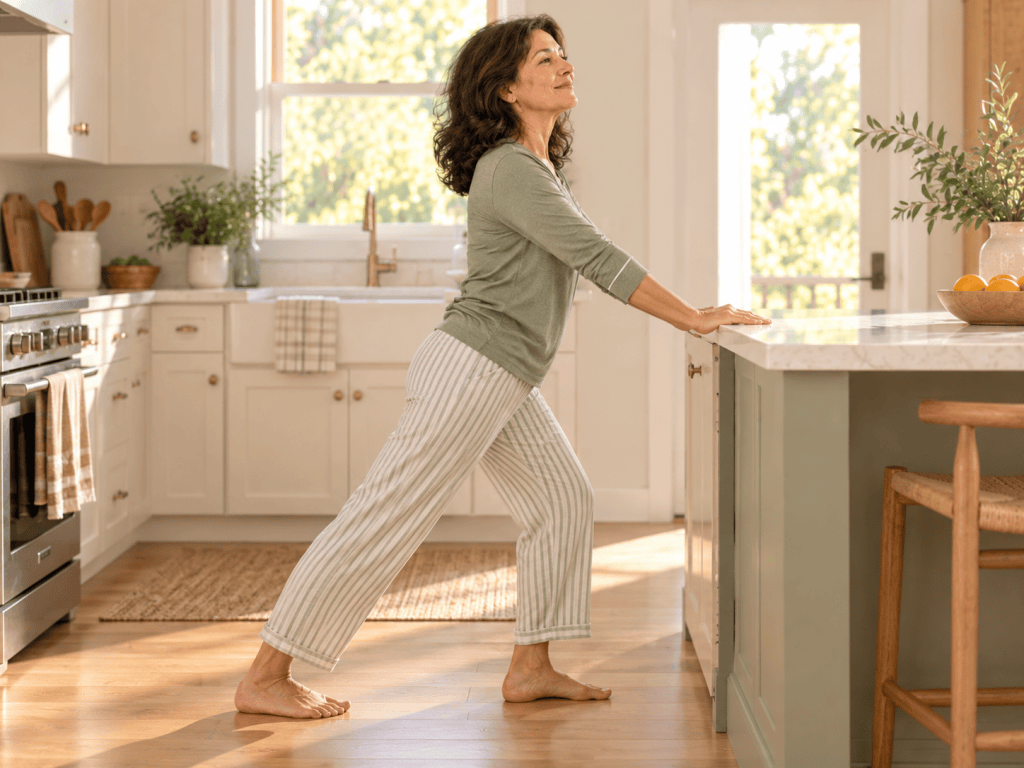
9. Calf stretch at the counter (1 minute)
Place your hands on the counter, step your right foot back, and press your heel toward the floor, keeping that leg straight. Hold for 20 seconds, then swap. Calves tighten overnight, and loosening them makes those first steps much easier.
10. Rise and breathe (1 minute)
Stand tall. Breathe in slowly as you sweep your arms up overhead, and breathe out as you lower them. Repeat 5 times. Finish with your hands on your heart for one last breath.

That’s it. Ten minutes, ten moves, and you’re ready for your day, or at least ready for your tea.

How to make it stick
- Pair it with something you already do. Part 3 fits perfectly while the kettle boils.
- Start with Part 1 only if 10 minutes feels like a lot. Three minutes in bed is still a win.
- Don’t wait for motivation. Do it on stiff days, sleepy days and grumpy days. Especially grumpy days.
- Give it two weeks. Most of us notice our mornings feel easier within a fortnight of doing it daily.
Gentle stretching won’t turn us into ballerinas (sorry), but it can turn the morning creak into a quiet « good morning ». And that’s worth ten minutes.
Over to you: what’s your stiffest body part in the morning? Mine is my lower back every single time. Tell me in the comments. 🌿
Your questions, answered
How long should I hold each stretch?
About 20 to 30 seconds, breathing slowly, with no bouncing. Gentle and steady wins.
Should stretching hurt?
No. You should feel a gentle pull, never pain. If a stretch hurts, ease off. If you have joint problems or a recent injury, ask your GP or a physiotherapist which moves are right for you.
Can I stretch every day?
Yes, daily is ideal. A short routine every morning does more for stiffness than a long session once a week.
Is it better to stretch in the morning or the evening?
Both work. A morning stretch eases the stiffness from a night in bed and wakes the body up, while an evening stretch helps us relax before sleep. Pick the time you’ll actually stick to.
Want a gentle start to your eating too? My free 7-Day Anti-Inflammatory Meal Plan is full of easy, plant-based meals that pair perfectly with a calmer morning routine. Grab it below.
— Your fellow Thriver, Zohra